
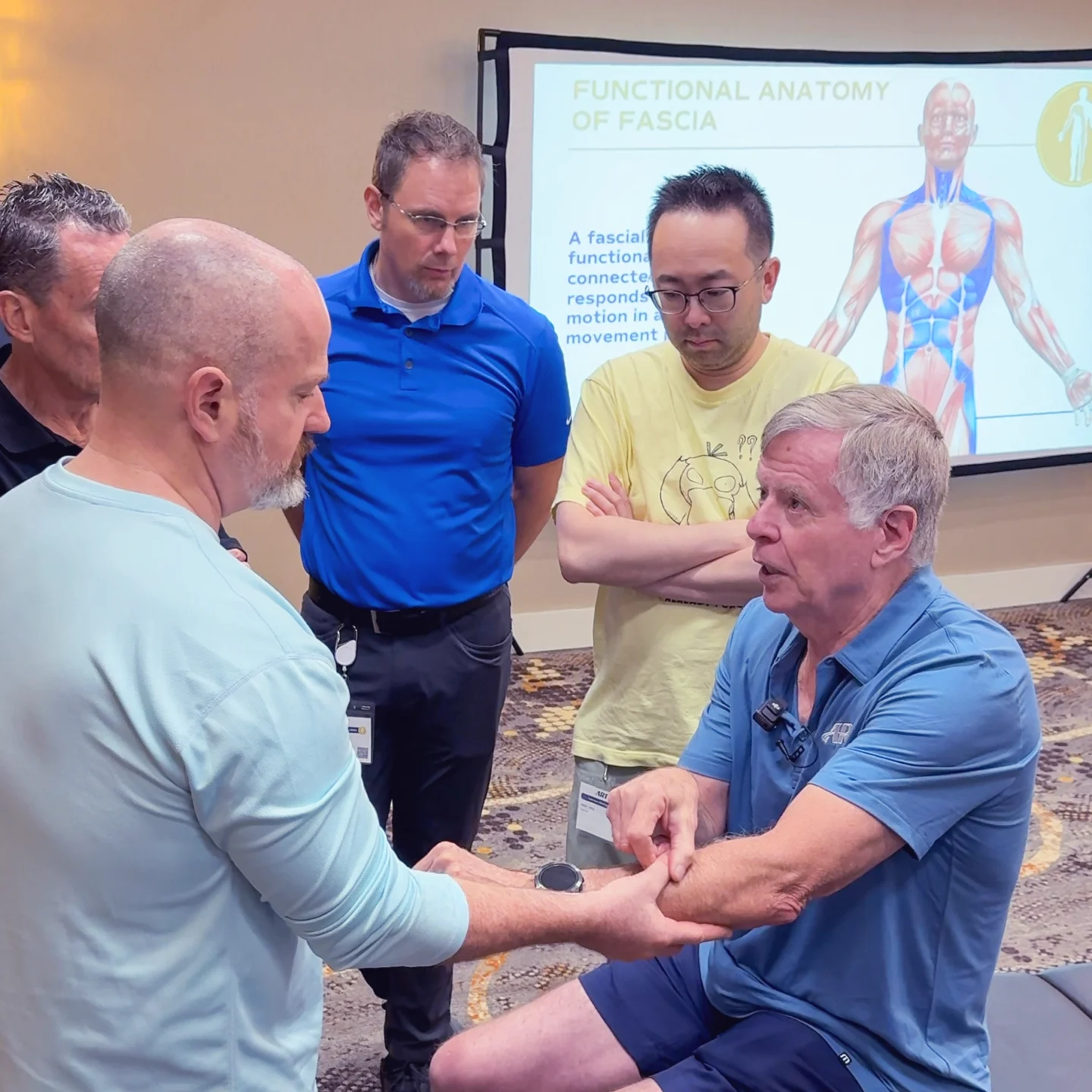
A Tissue with a High Level of Intrigue That We Still Don’t Fully Understand
Fascia has become one of the most frequently discussed structures in modern manual therapy. It’s referenced in continuing education courses, social media posts, treatment rooms, and research abstracts alike. Yet for all the attention it receives, fascia remains one of the most misunderstood, and inconsistently applied systems in clinical practice.
For medical professionals such as DCs, PTs, ATCs, MTs, and OTs, the question is no longer whether fascia matters, but rather whether we truly understand if and how to treat it effectively.
Common Misconceptions
Despite growing awareness, several misconceptions persist:
- Fascia is a separate system.
Clinically, fascia is often treated as though it exists independently from muscle and nerve. In reality, it is inseparable. Muscle cannot contract without transmitting force through fascial structures. Nerves glide within fascial planes. Vascular supply depends on its integrity. - Fascia is “melted” or reshaped through light pressure.
The idea that fascia can be permanently altered through superficial techniques lacks strong mechanical support. True structural change requires appropriate force, direction, and patient movement. Without load and tension, lasting adaptation is unlikely. - All fascia behaves the same way.
Superficial fascia, deep fascia, aponeuroses, septa, and neurovascular sheaths all have distinct properties. Teaching often oversimplifies fascia into a single concept, limiting clinical precision.
Fascia’s Impact on the Human Body
Clinically, fascia influences load distribution, joint mechanics, proprioceptive input, and injury patterns. Restrictions in fascial continuity can alter force transmission, change recruitment strategies, and contribute to compensatory movement.
Things we see frequently as practitioners:
- Chronic hamstring tightness that does not resolve with local stretching
- Shoulder dysfunction tied to thoracic or trunk fascial tension
- Persistent pain patterns that do not correlate with imaging findings
Fascia plays a role in these scenarios, not as a buzzword, but as a functional framework. When fascial tension is properly assessed and treated in context of movement, outcomes improve. When it is treated in isolation or conceptually, results are inconsistent.
The Educational Gap
Perhaps the greatest challenge is not recognizing fascia’s importance but rather teaching it appropriately.
Over the past decade, fascia education has expanded rapidly. However, progress in clinical applications has not kept pace. Many courses focus on theory, diagrams, and generalized concepts without providing repeatable assessment strategies or force application models. Providers leave with inspiration, but not always with systems. We must move toward precision.
That means:
- Teaching fascia within functional chains, not isolated regions
- Integrating movement with manual intervention
- Standardizing tension assessment and treatment parameters
- Demanding outcome-driven application, not anecdotal enthusiasm
As medical professionals, the responsibility is not to follow trends, but to refine systems that produce measurable change.
Fascia is not new. What’s new is our willingness to reexamine it. The next step is ensuring that we teach and apply it with the same rigor we expect from every other structure in the body.