By Dr. Ryan Comeau, DC
There are only a few clinical tools and techniques that genuinely change the outcome of the patient. Active Release Techniques is one of them.
I say that as someone who has spent the better part of a decade thinking about movement — not just how to treat it, but how to measure it, interpret it, and use it as a window into human functionality. That work led me to develop the Neural Planar Method, a framework for understanding how the nervous system organizes movement across three planes and why dysfunction shows up where it does. ART and NPM are independent systems that happen to work exceptionally well together — each rigorous on its own terms, each made more powerful by the other.
What Dr. Michael Leahy built with ART is rare in manual therapy: a system with true clinical specificity, a specialized educational standard, that generates unmatched patient outcomes. That combination is what draws both clinicians and patients to ART, and it is what has kept it as the “Gold Standard” in soft tissue treatment for so long.
In the NMSK Clinic
NMSK providers often see a specific kind of patient: someone who has often been in pain for a long time, has tried multiple interventions, and has developed movement habits around that pain that are now as much of the problem as the original injury. As practitioners, we work to restore joint mobility. But the soft tissue — the fascia, the muscle, the adhesions that have built up over months or years of guarding — that requires targeted, skilled manual work.
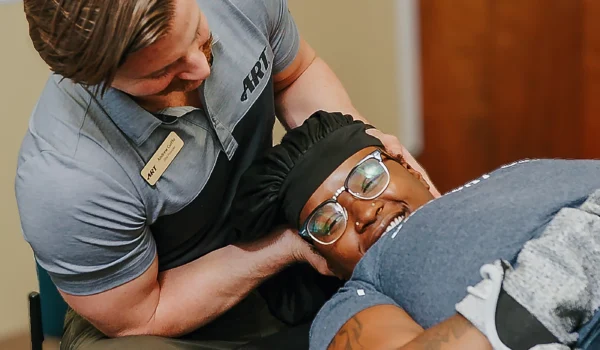
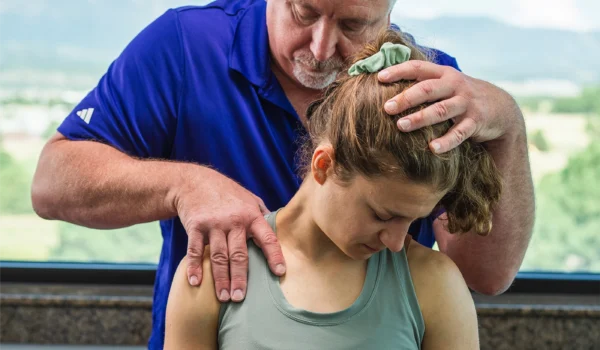
ART gives you that. The specificity of the contact, the tension, the movement through range — it addresses the tissue in a way that nothing else replicates. I have seen patients walk out of a session moving differently than they walked in. Not because something was forced, but because a restriction was released and the nervous system was able to access range it had been protecting against.
With the NeuroPlanar Method (NPM), we can take the 3 dimensional mapping of human movement using the Kinetisense motion capture system. This then allows us to apply techniques such as ART to the various joints that are highlighted in the system after a functional movement screen.
“This allows the NMSK provider to apply techniques such as ART to adjacent joints of the pain, or provide soft-tissue technique in the non-pain patient for performance applications.”
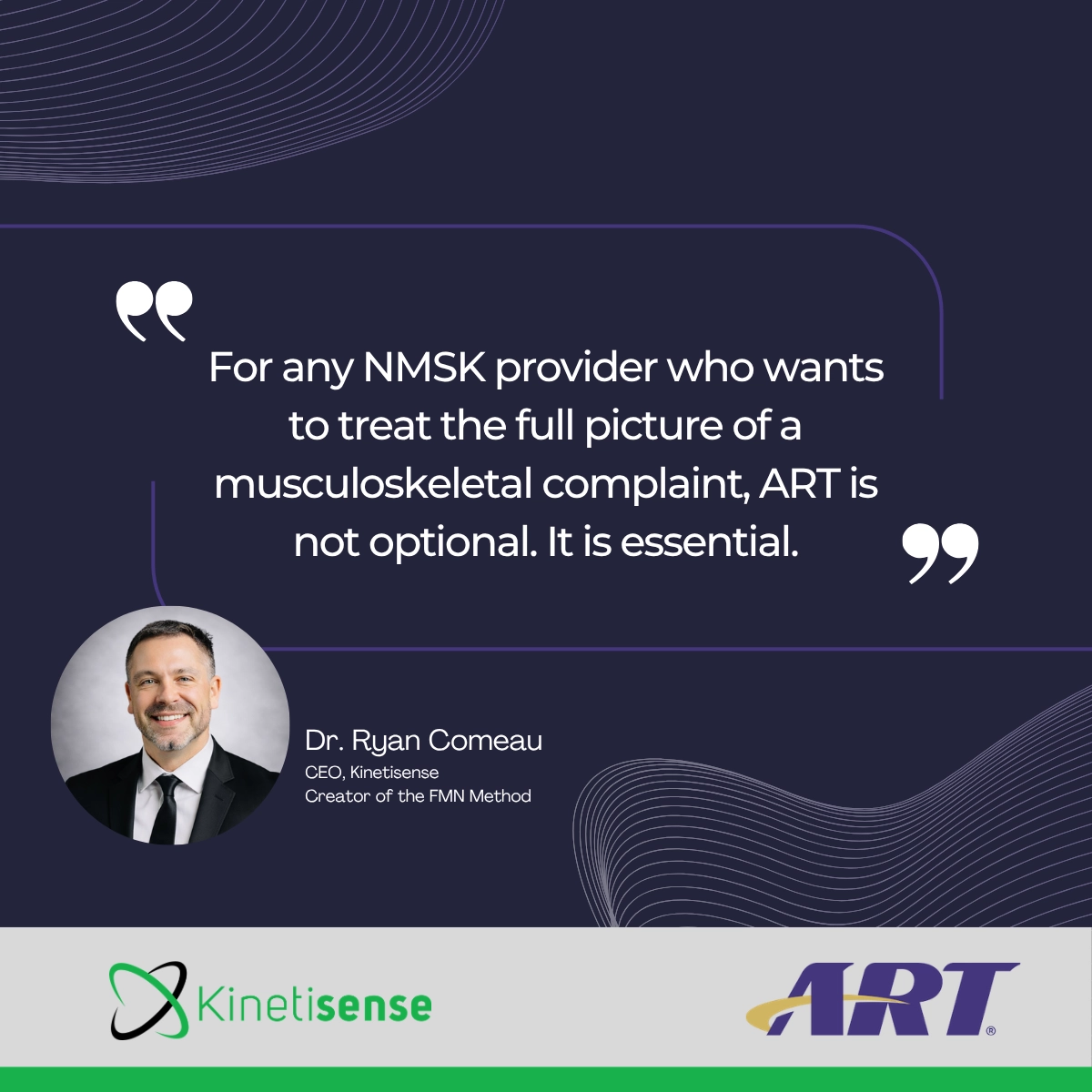
For any NMSK provider who wants to treat the full picture of a musculoskeletal complaint — not just the joint — ART is not optional. It is essential.
In sports performance
The athlete population demands a different framing. Consider a sprinter losing time off the blocks, or a pitcher whose velocity has dropped two miles per hour with no structural explanation. These are not pain patients — they are underperforming, and the reason is often a soft-tissue restriction, limiting range in a critical movement plane.
When you identify that restriction and resolve it with ART, you change the athlete’s available movement, not just their comfort level. Hip extension opens. Thoracic rotation returns. The kinetic chain can transfer load the way it was designed to. That is a performance intervention, not a rehabilitation one — and it is one of the clearest demonstrations of what skilled soft-tissue work can accomplish that I have seen in clinical practice.
What I have found to be true across both settings
The practitioners who get the most from ART are the ones who combine it with objective assessment. They are not treating a symptom — they are treating a pattern they can see, measure, and track over time. When you can document what changed and why, you build a clinical record that supports the patient, supports your decision-making, and supports the credibility of the intervention.
I use 3D motion capture in my own practice for exactly this reason. The before-and-after data from an ART session — captured objectively with 3D clinical motion capture such as Kinetisense provides some of the most compelling clinical documentation available. It closes the loop between what you felt in the tissue and what the movement system actually did with it.
The bottom line
ART is one of the most rigorously developed, evidence-informed manual therapy systems available to clinicians. The course structure is demanding for a reason. The specificity is demanding for a reason. The results, when applied correctly, reflect that rigor.
If you are an NMSK provider or a performance specialist who is not yet ART-certified, I encourage you to look seriously at the coursework. It will change how you treat — and more importantly, it will change how you think about what the tissue is telling you.
“Be systematic in your approach, from assessment to treatment to re-assessment.”
Dr. Ryan Comeau is a Doctor of Chiropractic and the developer of the NeuroPlanar Method, a clinical framework for neuromuscular movement assessment across three planes of motion. He is also the founder of Kinetisense, a 3D markerless motion capture platform used by clinicians and performance organizations in 25 countries. Click here to learn more about Kinetisense.